
Newsrooms get the fakes first and the blame fastest. The working tool for a verification desk is not a single detector, it is a deepfake detection tool comparison database search that narrows 60 tools down to the handful worth trusting with a broadcast decision. Here is what that search turns up, and the five checks to run on whatever survives it.
47 video tools, 24 with a stated benchmark
Of the 60 tools in our database, 47 record video support. Split them by integration and evidence and the field thins fast. 39 of the 47 offer an API, and of those, 22 state a benchmark while 17 state none. The 8 tools without an API do worse: 2 state a benchmark and 6 do not. In total, 24 of 47 video tools name the test behind their claims, and 23 ask to be trusted without one.
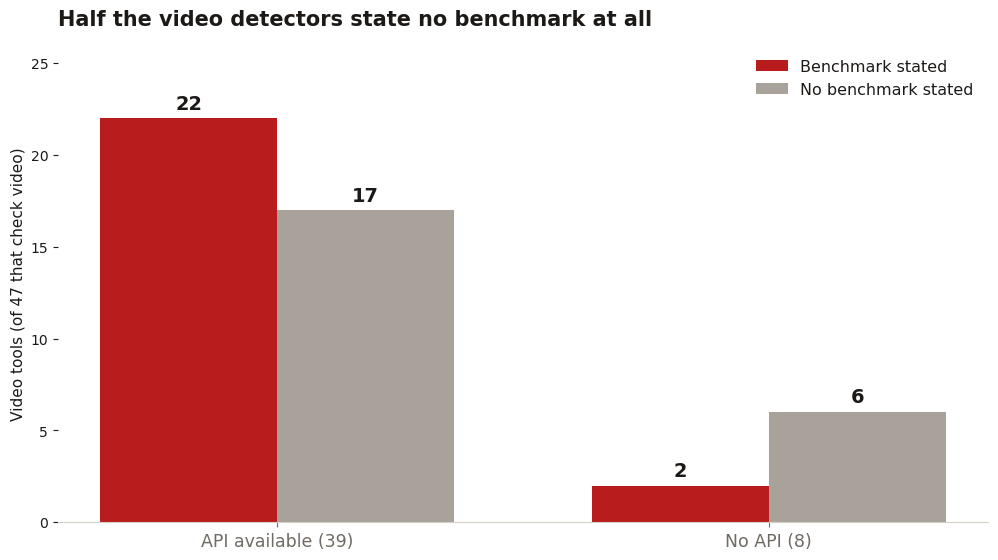
Stated benchmarks are not all equal, and the database records what each vendor claims, not what we measured. FaceTec points to iBeta and NIST PAD levels, BioID to ISO/IEC 30107-3 PAD testing, and Resemble AI Detect to named deepfake arenas. Those are checkable claims. A percentage with no test set behind it is not, and only 19 of the 60 tools in the database state an accuracy figure at all. The desk rule follows from the chart: a video detector that states no benchmark starts the conversation at a disadvantage, whatever its demo reel shows.
Five checks before the verdict reaches air
1. Provenance before detection. Check C2PA credentials first. A signed file from a known camera beats any AI verdict.
2. Frame-level scores. Whole-video verdicts hide the two manipulated seconds. NVIDIA's synthetic video detector reports 99.3% on frame-level benchmarks; ask vendors for the same granularity.
3. Ingest speed. If it cannot score faster than your wire feed, it will be bypassed during breaking news.

4. Audit trail. Sensity-style forensic logging matters when the verification itself becomes the story.
5. Revalidation cadence. Test against this month's generators, not last year's. Detectors decay as generators improve.
Sources: CISA
Provenance is the small family with the big future
Only 4 of the 60 tools record watermark and provenance methods, the smallest family in our method counts, and yet it is the family a newsroom should watch closest. Truepic, Serelay, and Numbers Protocol record C2PA in their benchmark fields, which means their pitch is not "our model spots fakes" but "this file carries a signed history". A signed file from a known camera settles in seconds what a detector argues about for minutes. The desk implication is practical: ask stringers and agencies for original files with credentials intact, because a stripped copy throws away the cheapest verification you will ever get.
Speed is the other desk reality the database can price in. 39 of the 47 video tools offer an API, and 48 of the 60 tools overall do, so automated ingest scoring is available from most of the market. What the comparison cannot tell you is latency under your wire volume, which is why the shortlist from a database search goes to a live trial on your own footage, during a busy hour, before any contract is signed.
Do not forget the other desks while you are at it. Only 9 of the 60 tools check text and 22 check audio, so the podcast and the press release have thinner coverage than the video package. A verification workflow built only around the video detector leaves the two fastest-moving formats to habit and hope.
Run the clip through DeepfakeDetect
The comparison database on this site is the same data behind the chart: filter the 60 tools by video support, API availability, and benchmark stated, then open DeepfakeDetect and run the actual clip through the checker while the desk debate is still theoretical. Detection is the second line. The first line is a verification desk workflow that treats every viral video as guilty until proven innocent, and a database search that shows its evidence is how the second line earns its place in that workflow.