Long explainers of deepfake detection usually walk through every method ever published. This page keeps the map shorter and spends the saved space on the question buyers actually ask: what do the scores mean once the media was not made by a generator the detector trained on? The method families below are the standard four. The accuracy evidence is this site's own: a leaderboard that runs 15 published detectors through one standard test, and a directory that records what 60 commercial tools claim, and mostly do not claim, about themselves.
Key takeaways
- Detectors read four kinds of evidence: spatial artifacts inside a frame, temporal inconsistencies across frames, frequency fingerprints left by generators, and biological or cross-modal signals a fake cannot keep consistent.
- On the test set they trained on, the best published detectors reach 0.96 to 0.97 AUC. On eight datasets they never saw, the best average 0.79. The gap between those two numbers is the product you are actually buying.
- Of the 60 tools in our directory, 41 publish no accuracy claim at all, and the 19 claims that exist use measures that cannot be compared with each other.
The four method families
Spatial artifact analysis. Convolutional networks read a single frame for the traces generation leaves behind: blending boundaries at the face edge, inconsistent lighting, skin texture that is too smooth, teeth and hair rendered as texture rather than structure. Temporal analysis. Video adds a second dimension: models that read across frames catch what a still cannot show, blinking patterns, lip movement that drifts from the audio, micro-expressions that never arrive. Frequency analysis. Generators upsample images through learned filters, and that process leaves periodic fingerprints in the frequency spectrum that survive even when the picture looks clean; spectral checks are cheap and catch a different failure set than visual ones. Biological and multimodal signals. Remote photoplethysmography reads the subtle color pulse of blood flow in a real face; audio-visual fusion checks whether the voice and the mouth agree. Ensembles combine families because each one fails on different fakes, which is why serious tools stack them.
Why accuracy drops in the wild
The cleanest demonstration is not a vendor claim but a controlled test. This site's benchmark leaderboard republishes the DeepfakeBench results (Yan et al., NeurIPS 2023): 15 detectors, all trained on FaceForensics++ (c23), then tested on eight datasets they never trained on. In-domain, the leaders are excellent: UCF at 0.9705 AUC, FFD at 0.9624, SPSL at 0.9610. Cross-domain, the same detectors average 0.7875 (SPSL), 0.7801 (UCF) and 0.7760 (SRM), and the field falls away below them. Three forces drive the drop, and each maps to a section of every long explainer: compression, which erases the fine artifacts spatial models depend on (platforms recompress everything); new generators, whose fingerprints differ from the training set by construction; and demographic skew in training data, which makes error rates uneven across faces. A detector is a snapshot of the generators that existed when it trained. The arms race is not a metaphor; it is the maintenance schedule.
The market, counted
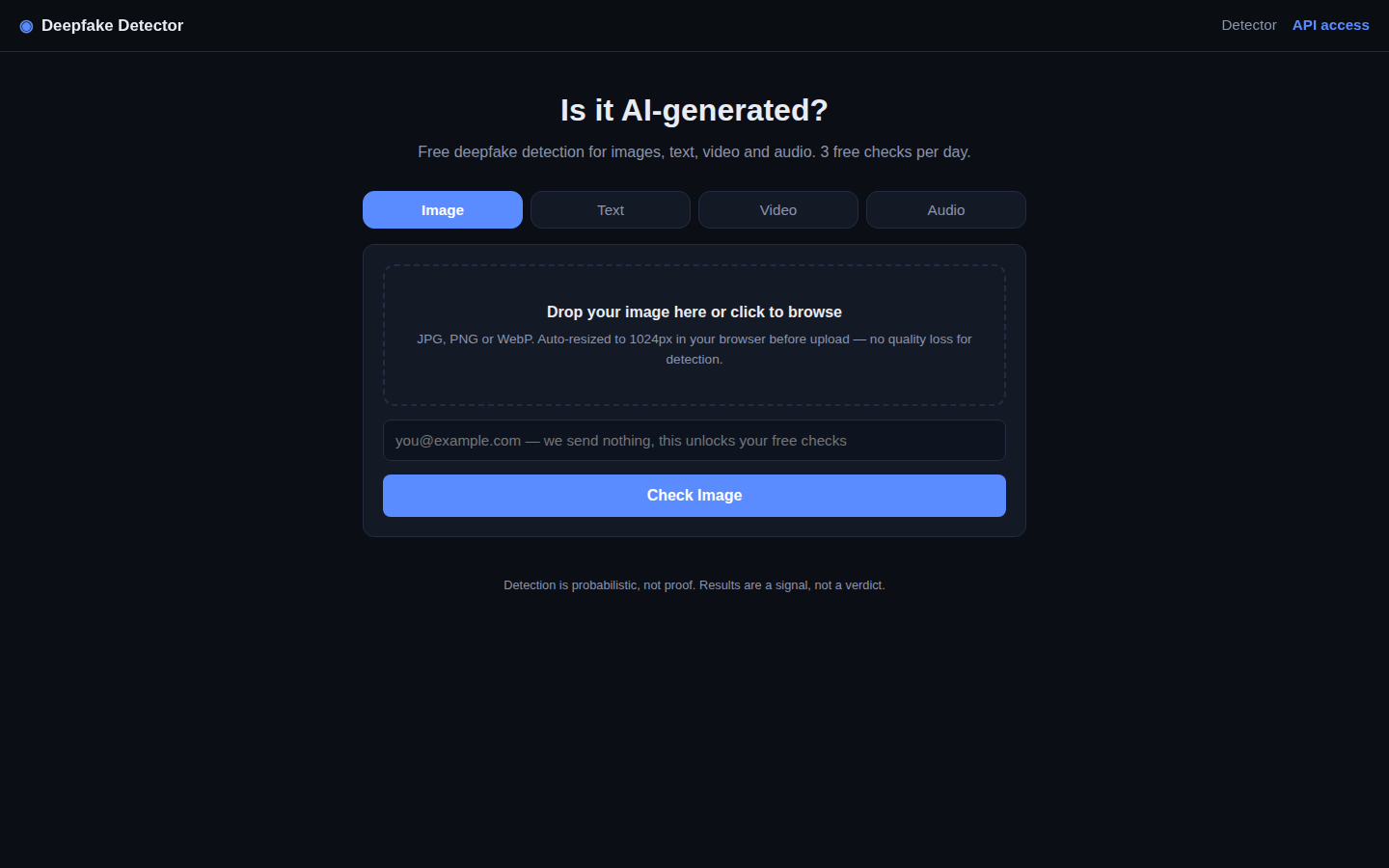
Our directory records 60 detection tools across the modalities those methods serve: 48 check images, 47 check video, 22 check audio, 22 check live video, and 9 check text (a tool can cover several). The accuracy picture is the honest scandal of the category: 41 of the 60 publish no accuracy claim of any kind. Of the 19 that do, the claims arrive as a 99 percent detection rate here, a 94 percent accuracy there, an AUC somewhere else, and several are not detection measures at all but liveness or identity-test results. Only 2 of the 60 name a public detection benchmark (FaceForensics++ or the DFDC) in their recorded materials. That is why vendor claims do not line up, and why this site ranks detectors on a shared test instead. You can run the consumer end of the same technology: DeepfakeDetect checks image, video, audio and text in the browser.
Frequently asked questions
Can detection tools detect all deepfakes? No. The best published cross-domain average on a standard test is 0.79 AUC, far from perfect, and every detector is weakest on the newest generators. Detection is a filter that raises the attacker's cost, not a proof.
How many deepfake detection providers are there? Our directory tracks 60 tools, from call-center voice specialists to multimodal enterprise platforms, and the count keeps growing; 48 of the 60 offer an API.
What does deepfake detection software cost? Mostly, vendors will not say in public: only 8 of the 60 tools in our directory publish a starting price, and 26 sell enterprise-only. The pricing picture is counted in the directory census.
What is the difference between detection and prevention? Detection judges media after it exists. Prevention tries to stop misuse earlier: provenance signing at capture, watermarking, and verification steps that make a fake useless even if it is never flagged.