This site exists to compare deepfake detection tools, and its directory now holds 60 of them. This post counts what the directory actually records about those 60 tools: how many offer an API, how many let you try before you pay, how many publish a price, which media they check, and how many state an accuracy figure at all. Every count comes from the recorded fields of the 60 directory entries, each one verified on September 15, 2026. It is a census of the directory, not a test of the tools.
Access: 48 APIs and 22 basic tiers
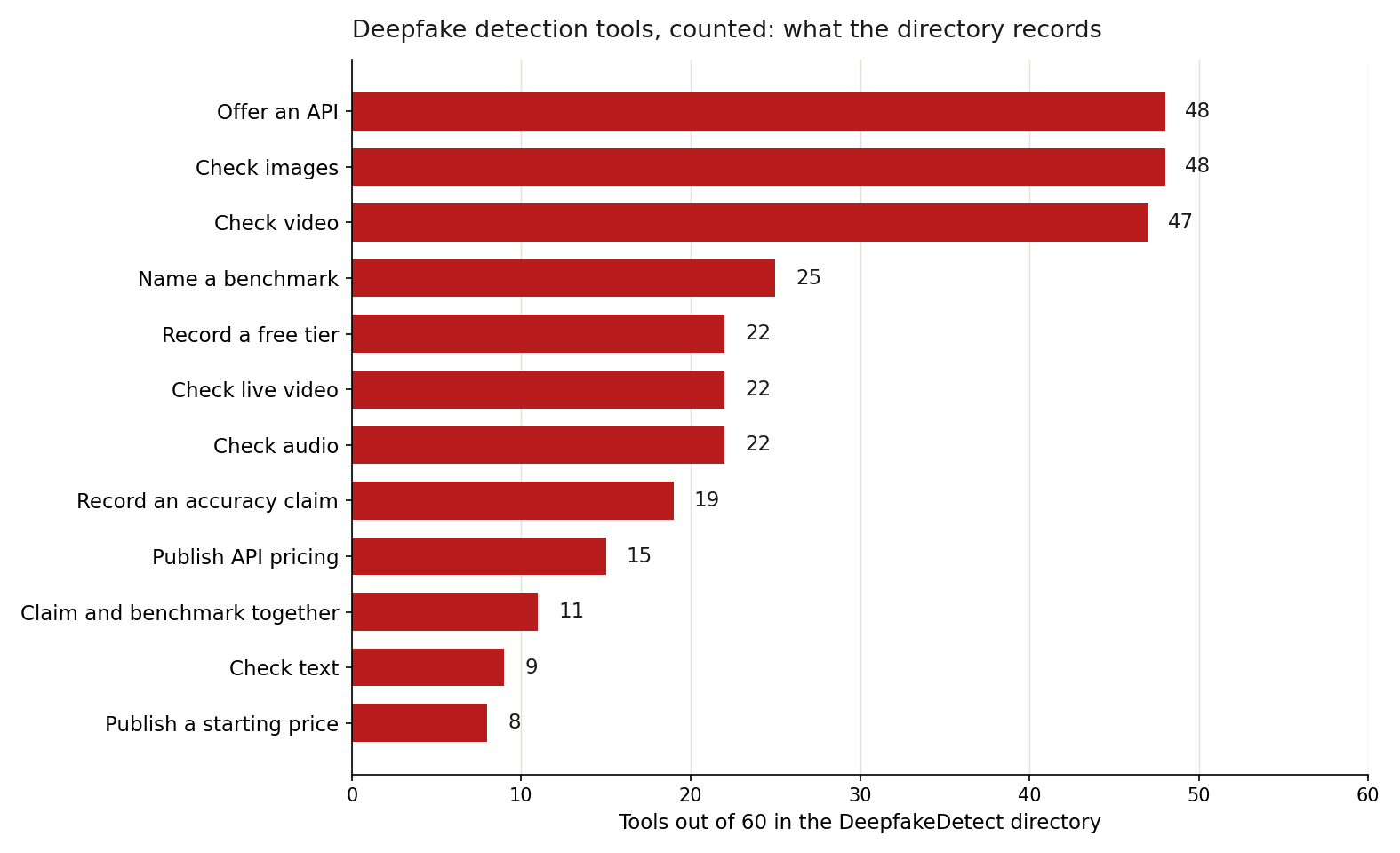
Forty-eight of the 60 tools record an API, so most of the field expects to be integrated into someone else's product, not just visited on a website. The 12 without one are reached through their own dashboards or an enterprise contract. Twenty-two tools record a basic tier, and that group is mixed: 11 are tiered products, 8 are available outright, 2 are usage-based tools with a allowance, and 1 is an enterprise product that records a basic tier. Thirteen of the 22 also offer an API, so a trial can often extend into a real integration test. The directory records that a basic tier exists, not what it limits, so read "basic tier" as a door to knock on rather than a promise about volume.
Pricing: only 8 publish a starting price
Pricing is where the directory goes quiet. The 60 tools split into 26 enterprise-only products, 12 tiered, 11 usage-based, 8 and 3 on subscription plans. Only 8 of the 60 record a starting price, and only 15 record what their API costs. For the other 45, the recorded price is a conversation with a sales team. If you are comparing tools, budget for that shape: the shortlist stage is public, the price stage mostly is not. Our API pricing breakdown walks through what integration really costs once the numbers do appear.
The media map: pictures everywhere, text almost nowhere
Coverage clusters on the visual. Forty-eight tools check images and 47 check video, 22 handle live video, and 22 check audio. Text is the outlier: only 9 of the 60 record text detection, namely Resemble AI Detect, Reality Defender, Blackbird.AI, Logically, Cinder, ActiveFence, Hive Moderation, Sightengine and Illuminarty. Our own DeepfakeDetect app checks image, text, video and audio, which puts its text check in a minority of nine inside its own directory. The shape of the directory is the shape of the market's worry so far: faces first, voices second, words last.
Accuracy claims: 19 stated, 11 benchmarked, 8 about deepfakes
Nineteen of the 60 tools record an accuracy claim, and 25 name a benchmark they were tested on. Only 11 do both. Fourteen name a benchmark but record no claim, and 41 tools record no accuracy claim at all.
We read all 19 claim texts in full and sorted them by what they actually measure. Eight are deepfake detection figures: Pindrop's 99% deepfake detection rate, Resemble AI's 94% accuracy for Detect-2B alongside an audio error rate below 6%, Sumsub's up to 99.98% deepfake detection efficiency, Paravision's 97% improvement in error rates over its own Deepfake Detection 1.0 (a relative improvement, not an accuracy rate), Innovatrics' deepfake error rates, Deepware Scanner's 93% authentication performance recorded against FaceForensics++ and the DFDC, and the 96% accuracy rates stated by McAfee and by Intel FakeCatcher.
The other 11 measure something adjacent. Two are face recognition results from NIST testing: Incode at 99.9%, and Veridas at 97.68% top-1 identification. Four are presentation attack detection scores from iBeta PAD liveness testing: FaceTec, Yoti, Aware and IDEMIA. Two are fingerprint systems: Tech5 in iBeta fingerprint PAD testing, and Precise Biometrics at 94 to 98% fake-fingerprint detection. The last three are Socure's 97.44% AUC for synthetic fraud, V2verify's 99.999% voice authentication success rate, and NICE's claim to identify 90% of fraudulent callers in the first seconds of a call.
Every one of these figures is a vendor claim, recorded as the vendor stated it on September 15, 2026. None of them is a measurement by this site, and no tool is ranked or recommended here on the strength of its claim. Why claims like these cannot be lined up against each other is the subject of our accuracy comparison. Scores that were actually measured the same way for every detector live on our benchmark leaderboard.
How this was counted
The counts were taken over the recorded fields of all 60 directory entries: media types supported, API availability, basic tier, pricing model, recorded starting and API prices, benchmark names and the accuracy claim texts, which were classified by a full read of all 19. The records were verified on September 15, 2026, and vendors can change pricing and claims without notice. Where the directory itself is inconsistent, we say so: only 7 of the 19 accuracy claims carry the directory's own "(vendor claim)" label, even though all 19 are vendor statements. Read every figure in the accuracy section as a claim.
If you have a file to check rather than a shortlist to build, run it through DeepfakeDetect: image, text, video and audio checks in the browser, 3 checks a day, no install. Our walkthrough of the app is in DeepfakeDetect: Checks for Image, Text and Voice.